
OSCE Parliamentary Assembly adopts The Hague Declaration
Hundreds of parliamentarians from Europe, North America and Central Asia are in The Hague from 4 to 8 July for the Annual Session of the Parliamentary Assembly of the Organization for Security and Co-operation in Europe (OSCE PA). The meeting concluded with the adoption of The Hague Declaration.
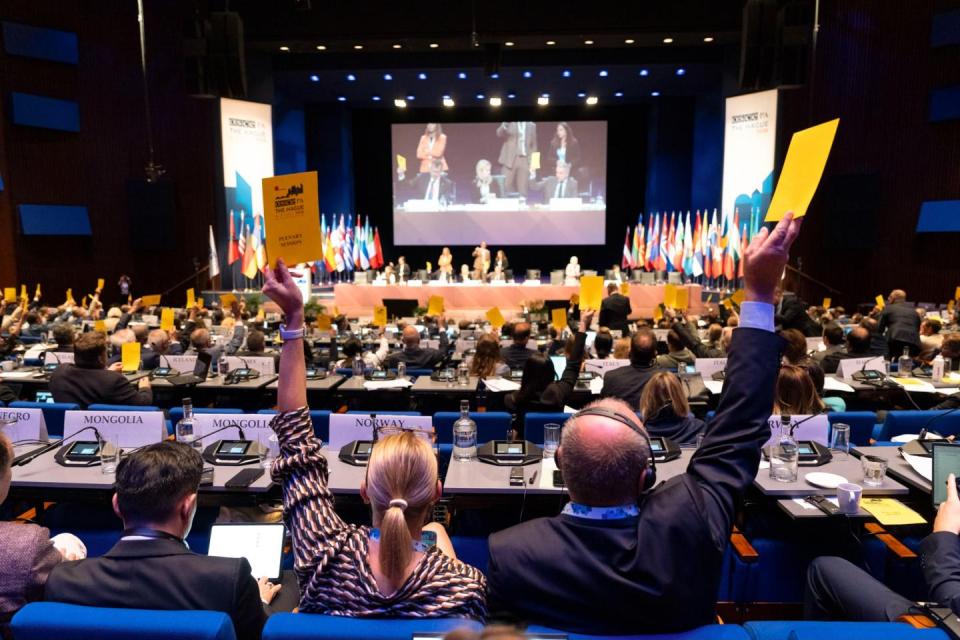
How can international law and shared values once again provide direction for security and co-operation in a period of geopolitical tensions? This was the key question during the Annual Session. The parliamentarians debated current crises, including the war in Ukraine, tensions in the Middle East, and the increasing pressures on democratic values. The meeting was organised by the Senate and the House of Representatives of the Netherlands and was held in the World Forum.
The Hague Declaration
The 33rd Annual Session of the Parliamentary Assembly ended with the adoption of The Hague Declaration. The declaration underlines the importance of international law and shared principles. These include the respecting of sovereign equality, the rejection of the threat or use of violence, the inviolability of borders, and respect for human rights and fundamental freedoms.
Resolutions
The parliamentarians voted on various resolutions in The Hague. The resolutions related to such matters as the war in Ukraine and European security, arms control and hybrid threats, climate and raw materials, and the impact of technology, including AI and cybersecurity. There were also calls for the immediate release of three Ukrainian OSCE officials. They were captured by Russia in 2022 and subsequently sentenced to lengthy terms of imprisonment.
Annual Session officially opens
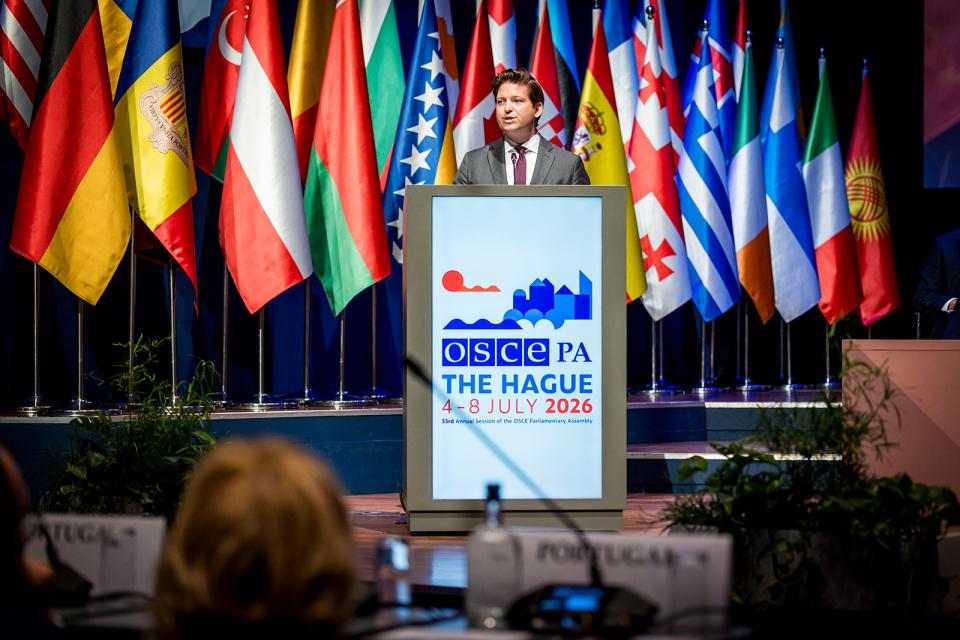
“International law and strong institutions are indispensable pillars of peace and security. Parliamentarians from all over the world come together at the OSCE PA in The Hague to find solutions to challenges that transcend national borders”, said President of the House of Representatives Thom van Campen. He delivered a speech during the official opening on Saturday 4 July, as did President of the Senate Mei Li Vos. “Upholding international law is our best chance of ensuring peace. Conflicts can be prevented by creating the circumstances for a free and democratic debate,” she said in her speech.
Diplomatic solutions
Prime Minister Rob Jetten also addressed the parliamentarians from more than fifty countries. He reflected on the role of the OSCE. According to Jetten, it becomes more important as international unrest increases, and with it the need for diplomatic solutions.
Video address by Volodymyr Zelensky
The Ukrainian President, Volodymyr Zelensky, delivered a video address. Ignazio Cassis, OSCE Chairperson for 2026 and Switzerland’s Minister for Foreign Affairs, and Pere Joan Pons Sampietro, the current Chairperson of the OSCE PA, also spoke during the opening ceremony.
Protecting shared values
The Minister of Foreign Affairs, Tom Berendsen, addressed the members of the Parliamentary Assembly on Monday 6 July. Among other things, he referred to the crucial role played by Members of Parliament in protecting shared values. For example, by making laws and holding governments to account for their OSCE commitments.
International law institutions
As well as political leaders, representatives from international law institutions spoke at the meeting. This includes Tomoko Akane, the President of the International Criminal Court, and Boštjan Škrlec, Eurojust Vice-President, who opened the plenary debate on Tuesday 7 July. The main theme of the debate was the role of international law.
Dutch delegation at the OSCE PA
The Dutch delegation at the Annual Session consisted of Senate Members Farah Karimi (PRO, the leader of the delegation), Mary Fiers (PRO), Boris Dittrich (D66), Rian Vogels (VVD), Madeleine van Toorenburg (CDA), and Alexander van Hattem (PVV), and House of Representative Members Mpanzu Bamenga (D66), Nicole Maes (VVD), Elles van Ark (CDA), and Fatihya Abdi (PRO).
Read more and watch back
Learn more about the OSCE Parliamentary Assembly and its Annual Session (including the programme). You can watch back all the plenary sessions and general committee meetings.
Aftermovie
See also the aftermovie below.
20260709 OSCE PA Annual Session Aftermovie
- WEBM-video (WEBM | 58.63 MB)
- Audio description (MP3 | 2.54 MB)
- Subtitle (SRT | 2.11 KB)